
To understand how badly the British state is mismanaging many of the places which make up the UK, it’s always striking to make international comparisons. For my new book Abolish Westminster, I thought it would be interesting to look at data from Cornwall alongside that from another remote nation in the North Atlantic famous for its […]
To understand how badly the British state is mismanaging many of the places which make up the UK, it’s always striking to make international comparisons. For my new book Abolish Westminster, I thought it would be interesting to look at data from Cornwall alongside that from another remote nation in the North Atlantic famous for its dramatic geology and unique culture.
Give us our resources!
Cornwall has a population of 585,000. Iceland is a little smaller – with just under 400,000 people – but not so different. Both have strong fishing, maritime and specialist mining histories. Both were, for centuries, at the remote fringes of the influence of far off capitals – London and Copenhagen. And both, in that context, developed their own, much storied democratic traditions – Iceland’s Thingvillar, and Cornish tin miners’ Stannery parliaments.
Now, both have vast potential geothermal power (though Iceland’s is more easily accessed) and rely heavily on tourism (though Cornwall is more easily accessed). But there, the comparisons end.
Cornwall’s Gross Value Added is around £25,000 per person – making it poorer than any country in Western Europe. Iceland’s, depending how exactly you measure it, is about three times bigger, per capita.
But this doesn’t express the full gap between the relative wealth and poverty of these two beautiful places. Because the stats also show that Iceland’s income per capita isn’t just higher. It’s also distributed much more equally than Cornwall’s. Where every journey I’ve ever made across Kernow has revealed a story about the conflict between hyper-luxury and grinding struggle, travelling around Iceland means trotting through relatively egalitarian communities, relaxing in the modest comfort common in Nordic countries.
Iceland today comes first in the world on the Human Development Index – which uses a range of measures to compare how good people’s lives actually are in different countries. According to the 2026 World Happiness Report, it’s the second happiest country on Earth, after Finland. But Iceland wasn’t always like this.
At the start of the 20th century, it was governed by Denmark, and one of the poorest societies in Western Europe. But its people overwhelmingly voted for full independence in 1944. With a population of less than 150,000, the new state took control of the levers of its own economy, and soon transformed itself into one of the richest countries in Europe.
If you think about how much cash travels up the South West peninsula in the form of mortgage payments to banks, supermarket profits and energy bills, subsidising well paid managers in the South East and London, and what an active Cornish state could do to build institutions to keep that wealth rooted, there is every reason to think that Cornwall needs serious economic powers of its own simply to stop the wealth it already generates from being sucked away.
The Cornish are different
This economic thought experiment, of course, sits alongside another basic fact: Cornwall has a distinct and deepening national identity. In the last census, one in six people living in Cornwall wrote in the nationality box that they were Cornish. While this isn’t yet a majority, it’s certainly a large portion of people (particularly given they had to write it in) and represents a unique phenomenon in the territory Westminster considers England. And that number is likely to grow – data from Cornwall’s schools suggests nearly half of pupils identify as Cornish (rather than English or British).
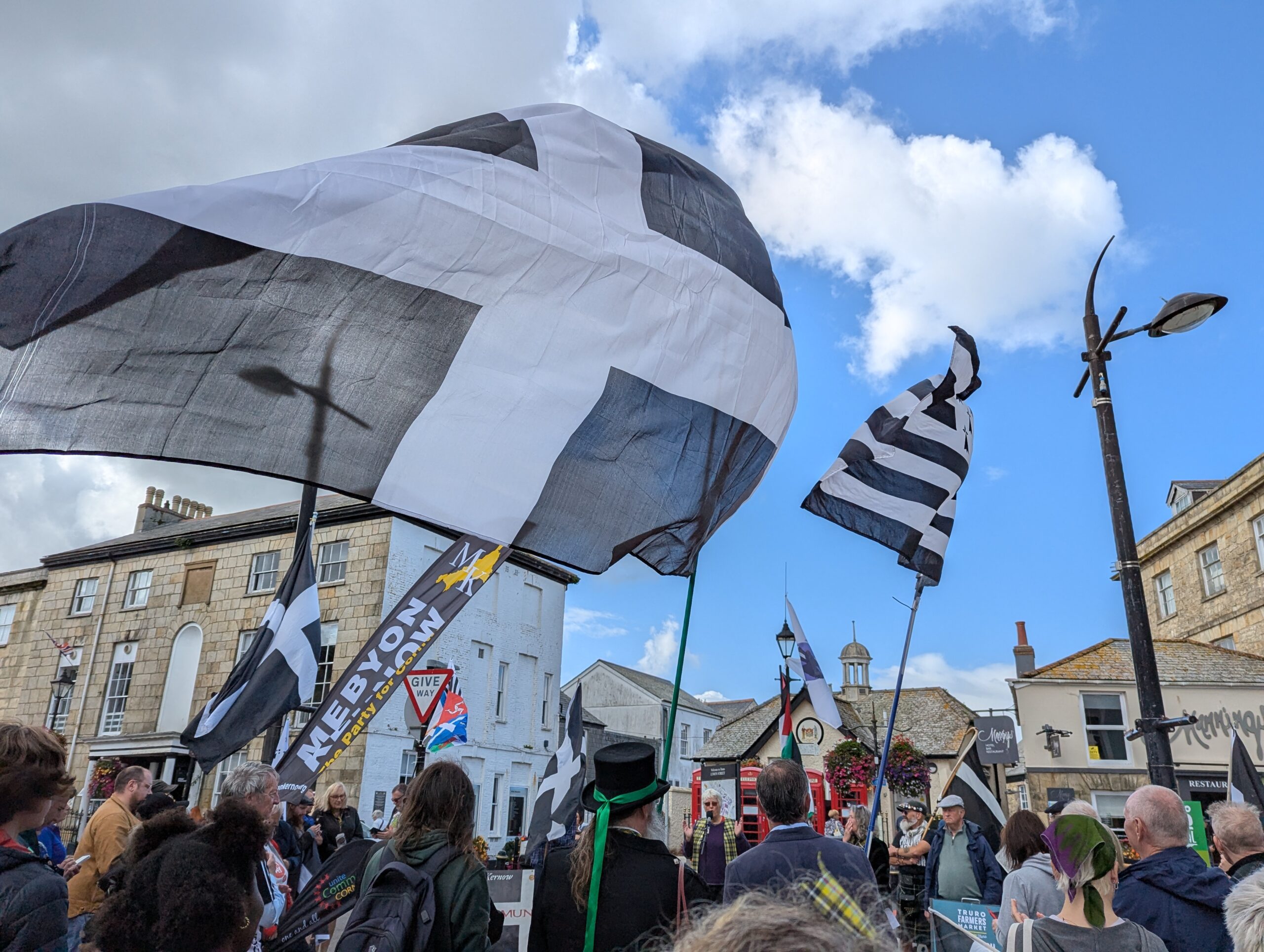
Most national identities are best understood as modern phenomena. For a couple of centuries up to World War Two, most people on Earth were ruled by empires, not nation states. The idea that “peoples” should govern themselves is in some ways a relatively new one, which arrived with demands for democracy in the 18th and 19th centuries. While Cornish identity certainly draws on a distinct language, culture and history – and mythologies about them – which go back centuries – the Cornish flag dates to the 19th Century; the language revival, launched around the start of the 20th century, has been accelerated by campaign groups and online forums. I understand that St Piran’s day celebrations are bigger than ever.
Sometimes, this sense that it’s a modern invention is used to undermine it. In reality, this timeline is perfectly normal – Iceland’s flag was invented in the early 20th century, most countries’ have emerged since then.
And modern Cornish identity has clearly taken on political meaning.
In England, there’s solid data to back up the idea that there is a close association between Anglicanism and Toryism which, among other things, tie closely to the relationship between the monarch, the established church, and the British state. Cornwall’s ancient language – and the Church of England’s failure to respect it – led to the rise of more democratic, non-conformist churches in the 17th and 18th centuries. This paired with the autonomist traditions of the tin miners to produce a political culture that’s a little different from that stiflingly deferential Anglican Toryism which still lies beneath the soil of much of rural England.
While this spirit is best imbibed through conversations rather than data crunching, it is seen in psephology: Cornwall’s longstanding free thinking tradition is now perhaps most obviously articulated by Andrew George, every radical’s favourite Lib Dem. And in the fact that Mebyon Kernow is a leftist party, and that the other party pushing for more autonomy is the Cornish Greens. If you want to see what this governing spirit looks like in a small, independent country, an obvious place with a similarly anti-authoritarian, leftish (compared to England at least) common sense is… Iceland.
It seems to me that modern Cornish identity has become a floating signifier for a more egalitarian future than that offered by a British identity struggling to get over the loss of empire, or by the broken politics of the British state. After speaking to many Cornish people over the years, it feels like a playful identity, open to the world and keen to meet its neighbours as equals. This is a good thing.
My book looks at how the British political system is set up, how it’s the most centralised political system in the western world, at how that vast concentration of power isn’t properly accountable to you and me, and so ends up being influenced by the rich and powerful. I think almost all of us can tell that this system isn’t working for most of us. In that context, thinking about what other systems might look like is important.
I’m not suggesting that Cornwall is about to declare independence, nor even necessarily that you should. The future of Cornwall should be up to the people of Cornwall. But with pro-independence governments leading Scotland, Wales and Northern Ireland, and support for leaving the UK slowly growing in each, you do need to think about how you would respond. If we don’t make plans for a better future, a worse one is guaranteed. And we’re not going to get to that future with the system which took us here.
Image via: Cobblestone Media.