

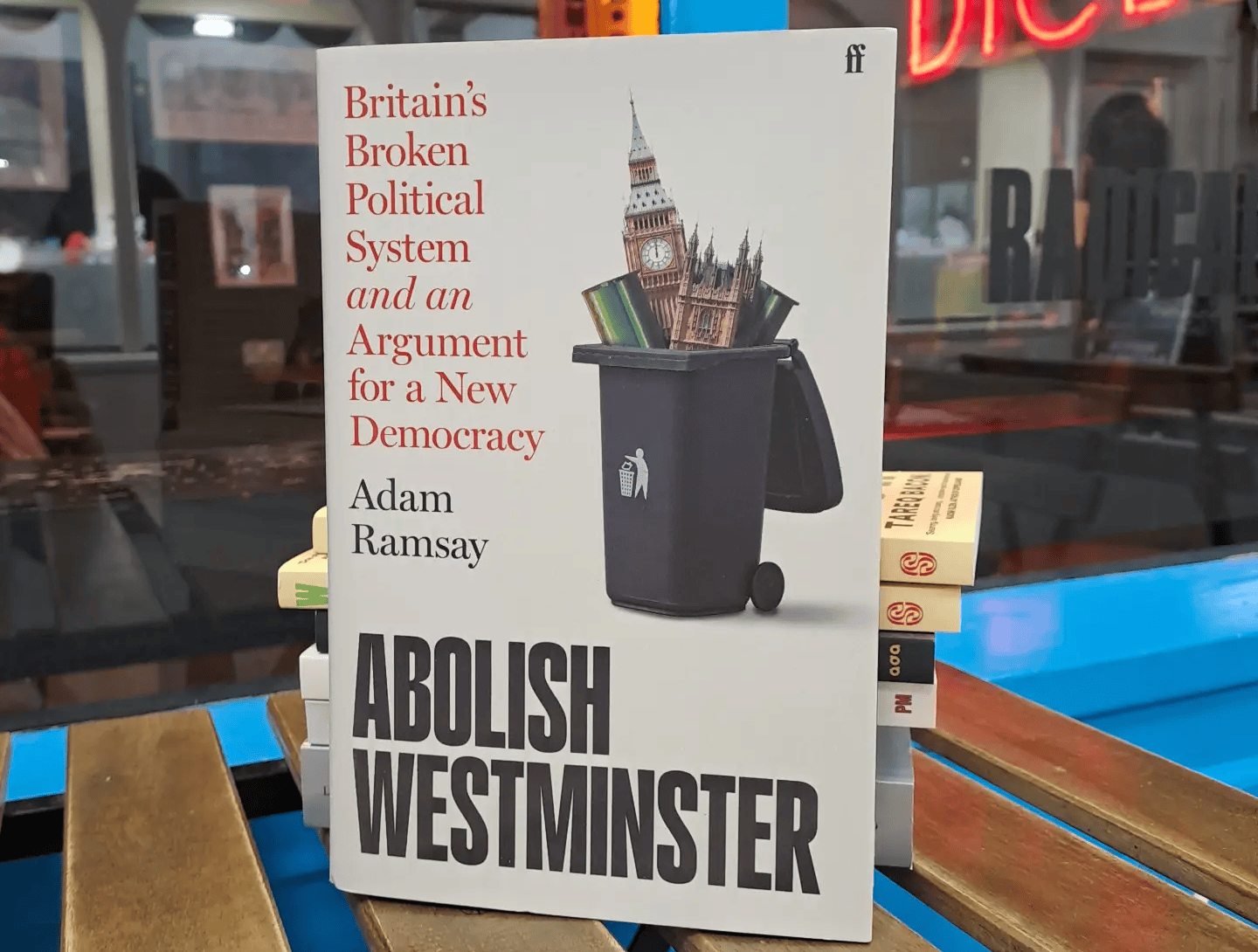
Adam Ramsay belongs to a particular literary tradition in Britain – specifically, one that wants to see the break-up of the United Kingdom. Based in Edinburgh, he has worked as a freelance columnist and journalist with the Guardian and Declassified and was a prominent editor for openDemocracy. His new book, Abolish Westminster: Britain’s Broken Political […]
Adam Ramsay belongs to a particular literary tradition in Britain – specifically, one that wants to see the break-up of the United Kingdom. Based in Edinburgh, he has worked as a freelance columnist and journalist with the Guardian and Declassified and was a prominent editor for openDemocracy. His new book, Abolish Westminster: Britain’s Broken Political System and an Argument for a New Democracy, offers a digestible analysis of the British state and how it manages to hobble on, dedicating its final section to the case for tearing the rotten system apart
Discussing the heart of the hodgepodge that is the British state, Ramsay describes a number of profound problems that have alienated a majority of the public. He characterises Britain as having “the most centralised government bureaucracy in the Western world”, marked by stubbornness on the economy, cruelty on security and immigration, and corporate capture in infrastructure, data management, and other areas.
The Privy Council – contrary to the assumptions of liberals who boast of Parliamentary Sovereignty – wields tremendous power by virtue of the Crown. This power is exercised through the executive, the Cabinet and, particularly, the Prime Minister, with an army of supposedly neutral civil servants at their heels.
Two things, then, remain constant: centralisation, which takes power out of the hands of British citizens (reducing us to mere subjects), and incompetence, which puts that power into the hands of “bullshitters” and the corrupt.
To the average optimist, it is a bleak image, to be sure, as Ramsay elaborates at length on the various problems of the way in which ‘ungovernable’ Britain is actually just mismanaged, dogged by the hangxiety of a fallen empire. Indeed his grasp on constitutional theory and debate is enough to convince any reader the whole thing could and should collapse. Though very brief in explanation, he gives a better idea, relinquish greater powers over legislation and regulation back to local communities, who understand their areas far better than those who see Whitehall as the Master of the Universe.
On Parliament, Abolish Westminster portrays the system as impotent and undemocratic, with a voting system that ostracises working people and places middle-class parties on a pedestal, leaving them susceptible to lobbying and ‘sleaze’ (corruption). A firm advocate of proportional representation, Ramsay says of First Past the Post that it “pushes voters to become amateur psephologists, trying to understand how to ‘tactically’ vote to stop those they hate – fuelling campaigning slogans like those used on Liberal Democrat posters – rather than considering what they want.”
As a Cornish resident, it’s hard to disagree. The entire peninsula swung from a Tory majority to a Labour majority in 2024 in a loveless landslide. On the whole, Westminster simply isn’t doing its job: it neither represents the broad classes of British society nor the ideas of the voters who make it up. And as for the House of Lords, well, it’s time for it to go – a position that, by this point, should be standard..
Whether in his analysis of the aforementioned institutions of state or their sharper edges (the judiciary, the constabulary, and the like), Ramsay attempts to drive home his key point: this is not inevitable. There exists a vast and deliberately obscure system in which, largely through ineptitude, the wealthy are pampered and protected while ordinary citizens are largely neglected. As populist as this argument might seem to some readers, it’s undoubtedly true that the British state’s bodge-job centralisation has made Andy Burnham’s devolutionary ideal seem plausible. Turning to London’s geographical ‘peripheries’, Ramsay argues convincingly for self-determination.
In its final section, the book puts forward a proposition: a remedial movement that, while splitting Britain’s constituent parts from one another, could vastly improve the lives of all the islands’ peoples. Ramsay argues that what binds this “uneasy union” together is a shared imperial project – a claim that anyone with even a cursory knowledge of colonisation and imperial administration would recognise. As popular historian Lawrence James pointed out when describing the violent suppression of the Indian Rebellion of 1857–58, those leading the charge over the hills of rural Punjab were red-faced Scotsmen. The same could be said of Cornwall and Wales, whose respective roles as mining ‘powerhouses’ of the early and later British Empire helped make British hegemony possible. In the wake of empire, the Celtic nations (and England) could achieve so much more if independent of this turgid system to which we remain attached, a millennium after its founding.
On Cornwall in particular, the average nationalist or devolutionist may feel disappointed by the space in the book dedicated to our small peninsula, but Ramsay does a fine job of analysing the current state of the movement for Cornish autonomy. He states that “While support for Cornish independence may be growing, it’s still marginal. Even Mebyon Kernow argues only for greater autonomy.” This is clearly true. The mood for greater sovereignty among the nearly 600,000 people who live here remains muted, despite the fact that many would like to see their identity represented with a tick-box. Furthermore, our potential to produce geothermal energy independently would, as Ramsay points out, make us one of the wealthiest nations in Northern Europe. Both ideologically and economically, Cornwall could be independent, but an awful lot of work needs to be done before we can discuss the prospect in the mainstream.
Abolish Westminster is not simply the latest diatribe against neoliberalism, a genre that has become commonplace among journalists and academics. Rather, like a diligent oncologist, Ramsay arrives at his conclusions through a careful examination of the history of the British state, which, as he argues, is centred in Whitehall rather than Parliament or local communities. And he does so very well. In this decade of revolving Prime Ministers, democratic stagnation and, nevertheless, a hopeful progressive movement for autonomy on London’s peripheries, Ramsay may have pushed on the open door to a progressive future for the people of these islands.
Image via: Instagram, Rubicund Books.
