On Monday night, Falmouth Town Council’s Planning Committee, a consultative body on the expansion of the town’s docks, discussed the issue in front of a packed audience, after councillors had requested it be “called in”. Those in attendance included all members of the committee, as well as other members of the council who wished to participate in the debate. Green Party Cornwall councillor Dean Evans stated plainly that this was the “largest planning application to come to the council in eight decades.” The town’s role as a consultative body only allowed them to comment on developments taking place onshore, as Cornwall Council is set to make a decision on developments in the dock itself.
The enormity of the consequences was not enough to deter the council from passing the motion put forward by the confrontational Mayor of Falmouth, Councillor Alan Jewell. Councillor Liam Howes was largely alone in his plea to the council on the matters of “pollution, noise, and socioeconomic damage” that would allegedly come from the docks expansion. Cobblestone has detailed those issues, as well as the specific “opportunities” in A&P’s request in a previous article.
Howes and Evans were alone in their argument because Councillors Jon Stowell and Jackie Walkden had given their opinions to the press regarding the dock’s expansion, leaving them unable to participate in the discussion or vote.
After giving a presentation on the work of their company in the local area and their application to dredge the docks, A&P’s Project Manager, Drystan Jones, and Managing Director Mike Spicer answered questions from the committee regarding the various and obvious pitfalls of the plan. This was before the committee heard from two speakers against the plan—Tim Hughes, an environmental academic at the University of Exeter’s Penryn Campus, and the other a fisherman from the local area.
Selling out to the Arms Industry.
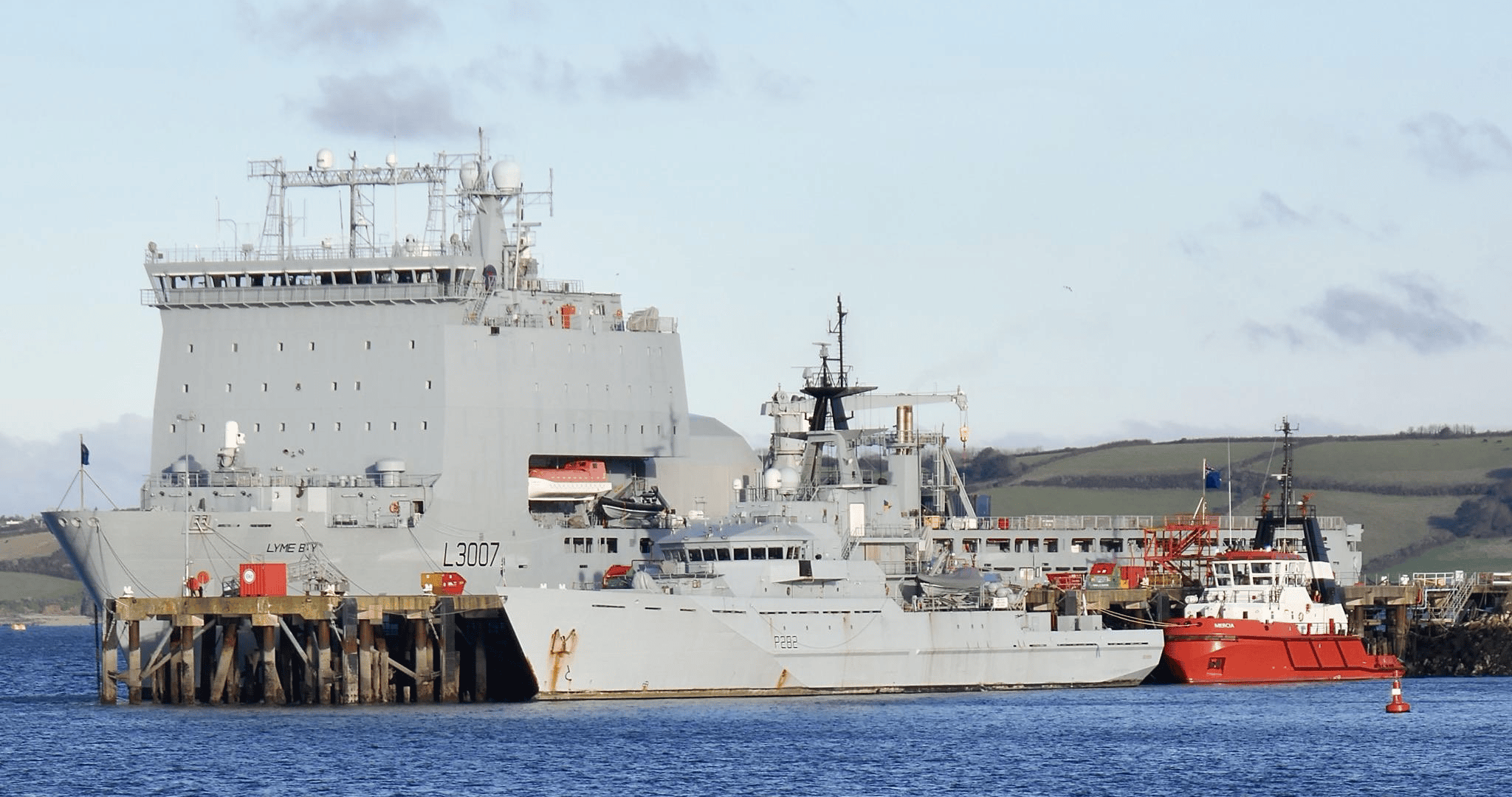
A&P’s relationship with the armed forces is well known, but less well known are its partnerships with BAE Systems, discussed in their opening remarks to the council. According to the Stockholm International Peace Research Institute, BAE is the world’s fourth-largest arms manufacturer and the UK’s main supplier of materiel overseas. Spicer stated that A&P receive assistance from the contractor in its repair and storage of large military vessels. One recent example is RFA Lyme Bay, an auxiliary vessel that is set to participate in “rescue missions” involving the nearly 200,000 British immigrants currently in the Eastern Mediterranean and Gulf.
Despite its prominence in the presentation, the committee neglected to question the role of the arms industry in the dock’s expansion, seemingly willing to take the presenters’ emphasis on “national security” at face value. It was stated by Jones that if A&P did not secure a Department for Energy contract under the Floating Offshore Wind project (FLOW), they could simply use this work to further increase A&P’s capacity to support the arms industry, with Spicer citing the involvement of the Ministry of Defence in the expansion’s planning. These two “opportunities” were stated as explanations for the heavy involvement of the government in the fast-tracking of the project.
Specifically, Spicer and Jones wish to see A&P take on ships that would usually dock in Devonport, for example the Type 23 frigates and Type 45 destroyers, both large auxiliary vessels requiring the kind of maintenance in which A&P specialise. At no point did any councillor question the prominent role of the military and defence contractors in this large-scale development.
More and more cruise ships.
The increase in cruise ships docking in the town was a sticking point for the committee. Cllr Sam Carmichael claimed he had spoken to local business owners who supported the project because of “increased footfall in the town”. Jones spoke of the exciting opportunities the increase in visitors would bring to Cornwall, implying that local businesses should learn to adapt to the desires of tourist populations.
Others warned against this, citing the overwhelming volume set to be brought in once developments are complete, at roughly 200,000 passengers—four times the current number entering the town every year. This increase was just one of the reasons that Cllr Howes gave for his motion to dismiss.
The cruise industry was later discussed by Tim Hughes, with the water and air pollution produced by cruise ships being of major concern to local residents and fishers. Despite this, those on the council, excluding Green, Falmouth Community Collective and MK members, remained unconcerned by this influx and the way it could impact pedestrian and highway traffic.
Killing an industry – water pollution and the turbines that make it necessary.
The last speaker to address the committee was a fisherman working in the Falmouth area. The damage this dredging could do to the fishing industry is well documented and substantial. The main concern revolves around the smothering of sea life from the dredging as sediment washes out in the unpredictable tide of the River Fal.
This also did not concern many of the more conservative councillors, with Mayor Alan Jewell seemingly forgetting the issue of job losses once the final discussion had begun. Independent Councillor David Saunby was similarly unfazed in his final opinion on the historic Cornish industry.
This environmental damage was somewhat downplayed when Jones and Spicer were given the opportunity to gush over their role in the Floating Offshore Wind project, claiming the sustainability of the project was a necessary goal for the local community. When questioned on the sheer unsustainability of the noise, water, and air pollution of the project as a whole, the presenters largely shied away from the point.
The Final Decision. Speaking on behalf of Falmouth?
Those few progressive councillors who wished to see the application struck down could not agree on the specifics of a motion, with amendments being traded and eventually dismissed. Cllr Jewell took the opportunity to pass the application, with a caveat from Cllr Carmichael that A&P seek to minimise the amount of traffic caused by the construction.
The impetus to modernise the docks was felt almost unanimously on the council, with Cllr Carmichael pointing to the imminent collapse of the Western Warf. And despite Howes’ plea that modernisation could be sought in a different way, Councillors Jewell, Clegg, and Carmichael saw the vote through.
Confirmatory decisions are yet to come back from the Marine Management Organisation and Cornwall Council. An interrogation of the plans would require the ward’s Councillor, Laurie Magowan to call in the planning application for discussion, which though proposed on Monday, is yet to be done.
Featured Image Via: Flickr.
Leave a Reply