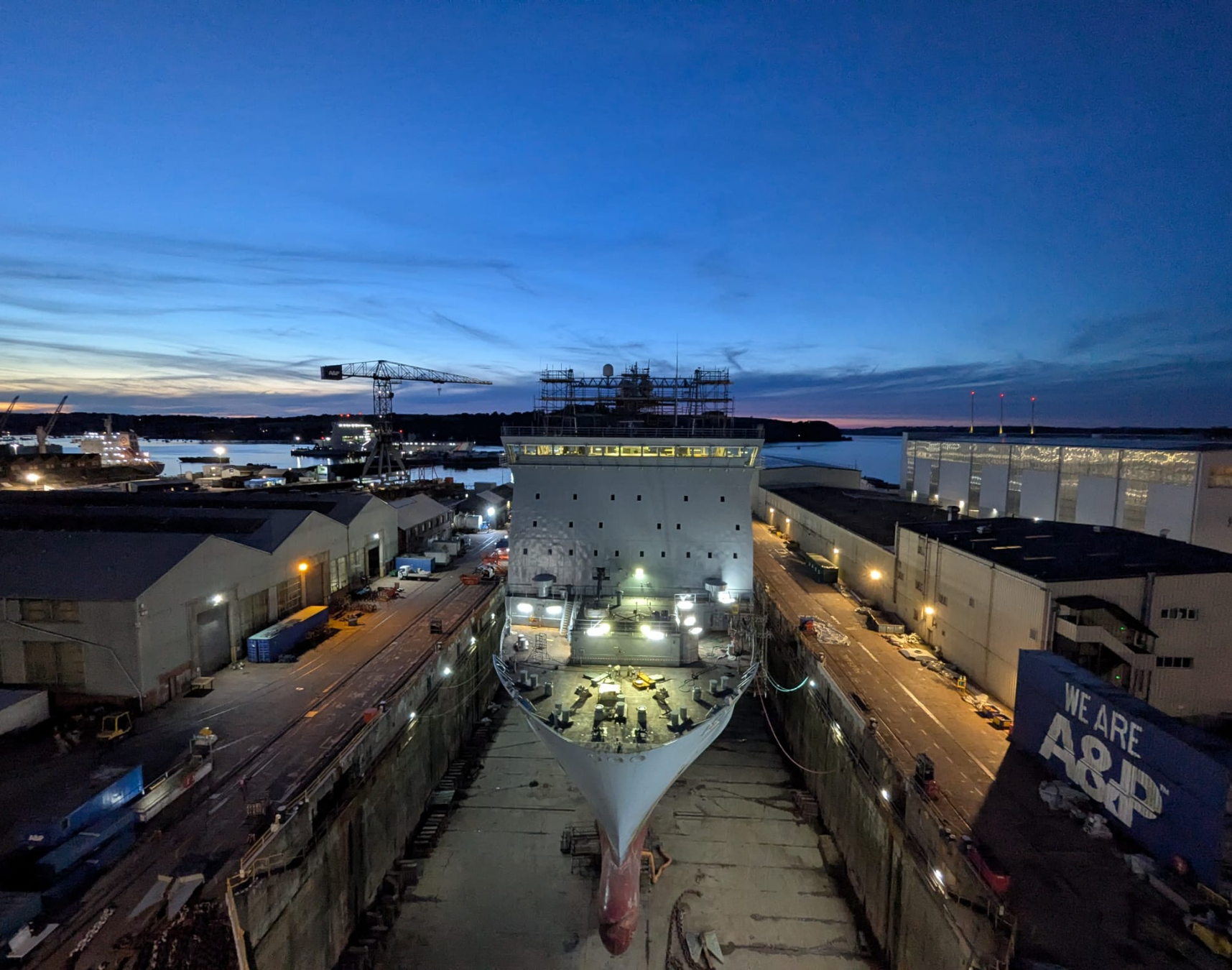
Suspicion is growing in Falmouth around plans to redevelop the town’s world-famous natural docks. Grassroots campaigners have begun to organise against the development, largely because of the enormous environmental cost that will hit the Fal Bay, and effects to local fishing communities. This has also been amplified with the emergence of the Docks’ new developer: Balaena Ltd, who purchased predecessor, APCL Group, and have stepped up in public profile and business activity.
An unaddressed aspect of the development, both before and after the acquisition, has been the prominence of the arms trade and its interests in pushing this undemocratic development. Balaena’s background, its public statements, and its role in pushing forward the Dock’s expansions heavily contradict the “green washed” arguments previously made in support of the infrastructure project.
Balaena floats to the surface.
In June 2026, Balaena Ltd purchased APCL Group, the parent company of A&P Falmouth, plus Falmouth Docks and Engineering Company as part of a £150 million acquisition. This brings shipyards in Birkenhead, Falmouth, and Tyneside into the company’s control – substantial growth for a company whose assets amounted to under £100,000 three years prior.
Upon their acquisition, Simon Gillett, founder and group Chief Executive Officer of Balaena, said:
“We are delighted to welcome APCL Group into Balaena. This acquisition reinforces our long-term commitment to British maritime capability – creating jobs, expanding apprenticeships, and driving innovation in line with the ambitions of the Strategic Defence Review and the UK’s Industrial Strategy.
“By uniting Balaena’s vision and ambition with APCL’s skilled teams in Tyne, Birkenhead, and Falmouth, we are strengthening the UK’s ability to deliver for both the Royal Navy and the global commercial maritime sector, while investing in the next generation of British shipbuilders and engineers”.
Gillett also stated that under Balaena, Falmouth’s shipyard would be “well-positioned to contribute to future naval programmes”, with shipyards in the network serving offshore energy, cargo, cruise, and ferry sectors.
When asked what this means for Balaena and Gibraltar (where the company is based), he commented that “we now sit at the top table with the MOD (Ministry of Defence) and with our other commercial customers.”
Like A&P, Balaena has worked extensively on ship repair contracts through BAE Systems. The Strategic Defence Review details key changes for the UK’s defence vision, including a “New Hybrid Navy” with nuclear submarines, cutting-edge warships and support ships, transformed aircraft carriers, and new autonomous vessels, alongside a “10x more lethal” British Army.
The Dredge.
One of the most destructive infrastructure projects ever to face Cornwall is set to be debated on 20th August by Cornwall Council’s Strategic Planning Committee. Setting out their plan for the Docks, Balaena’s website states that:
“Balaena’s vision is simple – to help make Falmouth a prime hub for the floating offshore wind [FLOW] sector – offering fabrication, construction, maintenance, port and marine services to developers and service companies.”
The company cites the £973,292 granted to Falmouth Docks from the Shared Prosperity Fund in 2023 to undertake an environmental impact assessment pertaining to the expansion of the Docks. They also claim that Balaena “will also explore options for the managed expansion of Cornwall’s year-round cruise tourism offer.”
Though originally pushed by A&P, Balaena has taken up the task for the Dock expansion. The proposed marine development caused controversy with local communities and nature protection organisations as early as October, when extensive plans to dredge toxic material from the seabed were announced. Campaigners say that the dredging will destroy the unique Oyster and Maerl beds in Falmouth Bay, and share concerns regarding the quadrupling of cruise ship passengers to the town. They also highlight the lack of community engagement, as the redevelopment has been fast-tracked through government planning reforms.
According to planning application, the dredging will be completed using a backhoe dredger. At the time of publishing, there is a backhoe dredger moored in Falmouth Bay – the Capall Mara – which was under maintenance at Balaena Falmouth earlier this month. It is unclear whether this particular vessel will be used for the dredging process.
Morale Man, Simon Gillett.
Balaena CEO Simon Gillett began his career in the Royal Navy, with a 6-year stint as a Weapons Engineer, including an Electrical and Electronics Engineering Apprenticeship specialising in ship sensors. Between 1994 and 2003, he held positions at multiple technology companies, including Sony and Psion Teknologix.
In 2004, he founded Innovation Motorsport, through which he attempted to convert a disused mine in Wales into a racing track. The company went into liquidation with an alleged £200,000 deficit after failing to acquire the necessary planning permission. Gillett claimed that he had not been involved with the company for a year before it collapsed, but according to company documents, he never sold his shares and only resigned as a director 6 months before the company went into liquidation.
His most infamous position was as CEO of Donington Park Grand Prix Circuit in Leicestershire, where he failed to raise enough investment to bring the circuit up to F1 standards, losing out on a 17-year contract to host the British Grand Prix. Speaking on the affair, Motorsport Vision Boss Johnathan Palmer said “I’m afraid Simon Gillett’s done that circuit no favours whatsoever. An awful lot of promises, very few of which ever came to anything.”
Soon after, Gillett founded South West renewable ventures E-tricity and Wave-tricity in 2010 and 2014 respectively. Wave-tricity liquidated in 2024 following a court order to ‘wind up’. This record of incorporation, fundraising, and ultimate liquidation caused has caused concern amongst employees of Balaena. Indeed, after Balaena’s acquisition of the Docks, a worker employed at the site spoke to the Falmouth Packet, alleging that “morale was low” and “questioned the track record of Balaena chief executive Simon Gillett.”
Gibraltar.
Until the acquisition of APCL group and Padstow Boatyard in May 2025, Balaena only operated at Gibdock in Gibraltar, managing the yard since 2022. Gibdock is one of the main employers in the colony, claiming to provide facilities that represent a 23% increase in the capacity of UK commercial dry docks utilised by the Ministry of Defence.
In 2025, Gibdock hosted a Defence Ship Repair Event at the House of Commons, bringing together key stakeholders from Government, industry, and the defence sector. Tan Dhesi MP, Chair of the Defence Select Committee, said of the event that “Gibdock is a fantastic, profitable, efficient shipyard that can bring a lot to UK defence”. With its flagship dockyard stationed in one of the world’s most important shipping lanes, Balaena has spent the previous 4 years positioning itself to sit “top table” with the most prominent state and private actors in the global arms trade.
The constant flow of comms from Balaena has flooded the press in recent weeks, as the company desperately seeks control over the narrative. The expansion is currently coming under increasing scrutiny from the Stop the Dredge campaign, who have mobilised dozens of local residents to public meetings and regularly speaks up in outlets such as the Guardian.
Image via: Cobblestone Media.

Leave a Reply