
Matt Blewett (Left) and Phil Nile (Right). “So I’m not allowed to say ‘fuck’ or ‘bugger’?” It’s one of the first things Matt says after I switch on my recorder. I’ve managed to get half an hour with Matt and his partner Phil in a café, just days after the Daily Mail went into a […]
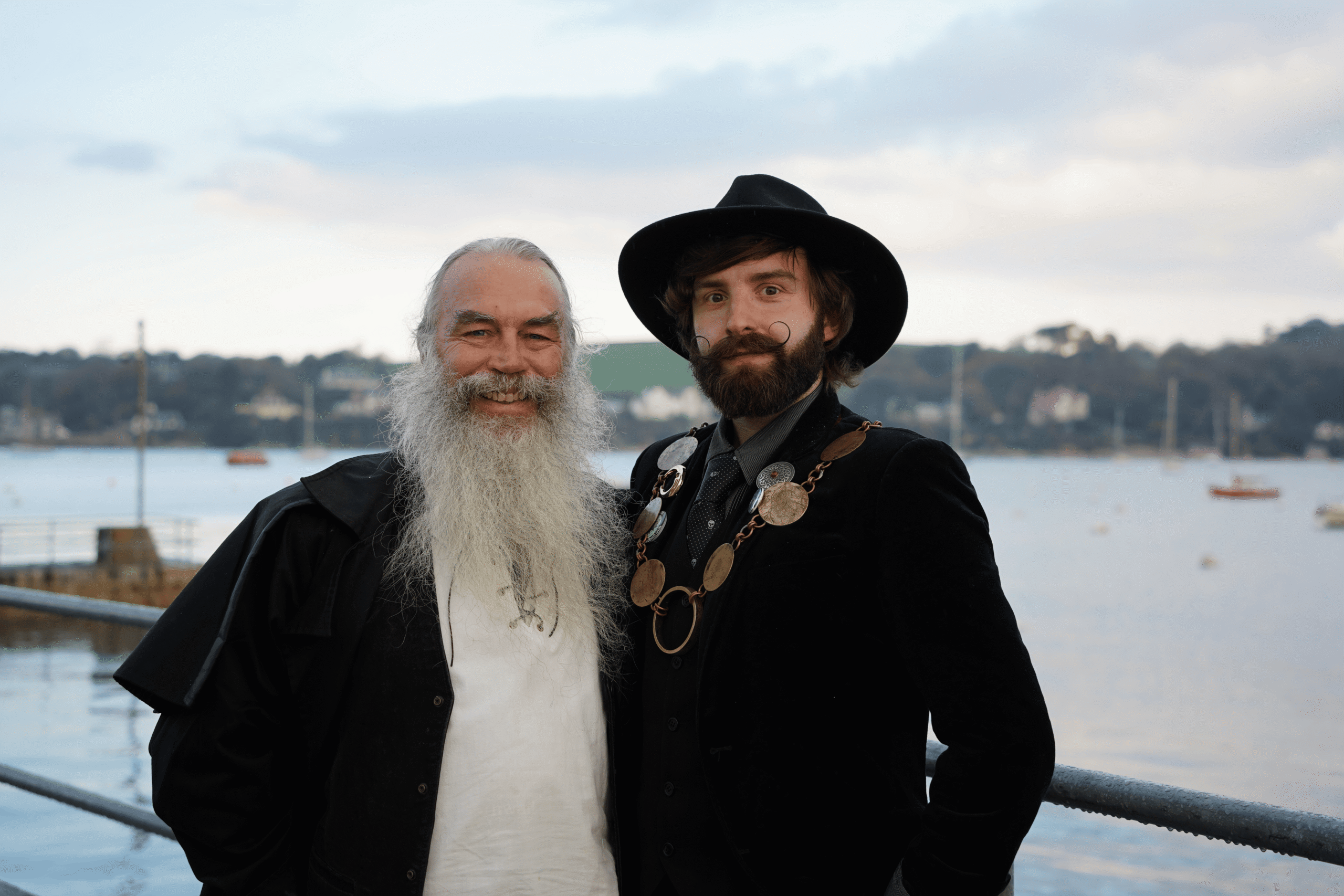
Matt Blewett (Left) and Phil Nile (Right).
“So I’m not allowed to say ‘fuck’ or ‘bugger’?”
It’s one of the first things Matt says after I switch on my recorder. I’ve managed to get half an hour with Matt and his partner Phil in a café, just days after the Daily Mail went into a moral panic over a festival the two had been instrumental in creating.
I know of Matt Blewett through his activist work – the LGBTQ+ Mock Mayor and Montol being the most celebrated among them. After briefly explaining his journey in and out of Cornwall during his early years, Matt tells me he moved back to Kernow in 2014 to work in the Cornish language office. He explains his involvement in promoting the Plen-an-gwary project – Kernow’s answer to the amphitheatre – and his later work with language group Agan Tavas.
Phil Nile, originally from Fowey, winces slightly when I suggest he’s a bit of a mystery, as he was hard to find online. He admits he lives a relatively private life and tells me he got into activism through meeting the man sitting opposite him and “reading all of his tweets”, of which there are a great number. He is reserved, and yet speaks as deeply as Matt does about the inclusion of LGBTQ+ people in his local community.
Queer and Cornish?
Cornishness and Queerness seem in tension at first. Tired stereotypes of Cornwall’s suspicion of the outsider are not entirely undeserved. While hate crime numbers are low, there does exist a certain coldness towards most things ‘queer’. Matt quickly rubbishes this, however, insisting on a powerful link between the two. Though he didn’t set up Cornwall Pride, he has been an ardent supporter since his return to Cornwall, viewing it as inseparable from other community engagement.
“Everywhere you go in Cornwall you have these communities, you’ve got people who are aching to express themselves. They feel unable… but if you rock up with a Pride bus, they feel they can be themselves. LGBTQ+ culture has always been a part of Cornish culture, though it’s sometimes difficult for people to recognise that, because there’s always niches within the culture.”
They tell me they were certainly not the first to come up with the idea of the Mock Mayor, but were the first to make the tradition explicitly queer. There have been Mock Mayors in Helston (the Mayor of St. John) since the 1850s, in Penzance since the 1890s, and in Penryn since 2016. In the 2020s, the tradition is supported by local authorities in those cases, but the figure of the Mock Mayor is as important to rural anti-establishment politics as peasant rebellions.
Matt hints at the idea of “topsy turvy” politics, in which the leader of a local community is derided by their camp counterpart, the Mock Mayor. He tells me the Mock Mayors were often from the poor part of mayoral towns, areas which were onlookers to local democracy, rather than participants in it – and makes a direct suggestion about today’s sense of detachment from the public sphere.
Phil celebrates how local performers have used their LGBTQ+ Mock Mayor events to launch careers in the past, and how he, the current Mock Mayor has used it not only as his opportunity to perform, but to bring the community together. *Explain about his ceremony and the work of the Mock Mayor in bridging the gap between queerness and cornishness as a wrapup.*
Montol, the Daily Mail, and the Nuremburg Rallies.
Roughly a week before we sat down together, Daily Mail columnist and conservative popular historian A.N. Wilson penned an article entitled “Are we plunging into a new dark age?”. The piece took aim at the neo-paganism of modern folk festivals and lamented the decline of organised religion that, he argues has caused it. Published a day before Halloween, its meandering subject matter took an odd turn when Wilson cited Montol, comparing it to the Nuremberg rallies:
“And when I watch the parade and see the excited, sweaty faces reflecting the flares, why do I sometimes think of the Nazis’ Nuremberg rallies, whose torchlit processions were their climax?”
This reference to a beloved and “great” Cornish institution was seemingly tongue-in-cheek, but both Phil and Matt saw something deeper in Wilson’s writing. The unfounded comparison of Nazism to centuries-old Cornish traditions of the occult hit particularly hard, as they are both key participants in the yearly Montol celebrations, though it started in 2007. Matt said of Wilson:
“He’s a pathetic twat, a Christian nationalist. As far as I’m concerned, he’s a nasty individual who is anti-Cornish, and that’s how I see it. He’s disrespecting Cornish culture but at the same time using it in a Christian nationalist kind of way, insisting that we mustn’t be Cornish and we’ve got to be Christian. Not even just Christian, but the JD Vance version of a Christian.
“Montol are outraged. The trustees are horrified by the way that Montol had been misrepresented in that article. There is nothing about Cornish culture that is comparable to Nazi rallies.”
Phil zoned in on the tone of the article, and the “fears” that Wilson spoke of in his article, which he said allows conservatives to “batter anyone into a straight line”. He claimed of Wilson and others that their apparent fears over cultural difference allow them to do a significant amount of damage to those who are different in any way. Their outrage is pared with a mocking of Wilson’s stuffiness, and his adherence to a kind of conservative politics long forgotten by the mainstream.
Making a difference
I take them down to the pier near the coffee shop to grab a photo or two. The three of us exchange observations about where the Cornish movement is heading and the role they play in it. The introduction of Kernewek into child and adult education, the addition of road signage in Kernewek and the preservation of uniquely Cornish cultural practices have all helped Cornwall strive for recognition as a nation.
Their role in queer advocacy here seems similarly vital. The mere presence of Pride, in its various forms, allows those living in isolated communities to feel that they can be themselves at home, rather than feeling the need to escape to cities.
Though far too humble to admit it, Matt and Phil have had a significant influence on grassroots community struggles for emancipation and recognition. They’ve turned older traditions on their head in a way that reflects the real diversity of Cornwall’s communities, and will likely continue to subvert our expectations.
Image via: Cobblestone Media.