
Polling for the May 2026 local elections hasn’t come as a shock given the poor performance of the Starmer cabinet in their year and a half of government. A whopping thirteen U-turns on issues as fundamental as the two-child benefits cap, the grooming gangs inquiry and most recently Digital ID, has put them in a position of popularity worse than any other modern British government.
Polling for the upcoming elections – those still being permitted to hold a ballot – looks bleak for Labour. Unlike those in May of last year, this year’s elections will primarily take place in metropolitan authorities like Birmingham, as well as the London Borough councils, with Britain and the North of Ireland’s parties fighting for over 4,000 seats in 109 local authorities. This is massive compared to the 1,300 or so seats contested across 24 authorities last May, and will likely bring Starmer’s tenure in office to an end if they’re trounced.
And that is looking likely. The Green Party under Zack Polanski has come leaps and bounds, with the party declaring a 45% increase on its membership in his first month as leader and reaching to the highs of 175,000 by November. Reform will, of course, take a large chunk of what were once Tory seats and look set to take many of Labour’s also. The polls make it seem as though England will be a battleground between the Greens and Reform to see just how much of the two-party empire they can dismantle.
But that isn’t the whole story, and something more interesting is brewing in the hinterland of Britain and the occupied Six Counties. Celtic nationalism in various forms is grasping the opportunity to fill national and regional assemblies, and if predictions from pundits and pollsters are to be believed, they will smash Labour to pieces at the May election.
Cymru – Wales: Plaid vs Reform.
The Caerffili by-election was not, as some pundits said, an overinflated example of theatrical politics. Nor was it a materially unimportant by-election in a small southern Welsh town. It was the microcosm of things to come – where Labour’s irrelevance and incompetence gives voters two choices: Reform’s fascism, or Plaid’s left-wing progressivism. Bringing to an end a century of Labour dominance in the constituency, Plaid Cymru’s Lindsay Whittle got a phenomenal 15,961 votes, 47.4% of the total cast. Reform, close behind on 36%, captured media attention as their English leadership went to door-knock and campaign. It made clear to those in Westminster that whether left or far to the right, things were going to change.
In May, the Welsh people will go to the polls in the first vote by proportional representation in the Senedd’s history. Polls predict that what happened in Caerfilli will happen writ-large across Wales. One poll published this month by YouGov predicts Plaid Cymru out in the lead, with Reform trailing by 14 points. And however odd it may seem in the history of Welsh politics, Labour sit close to last place on 10 points.
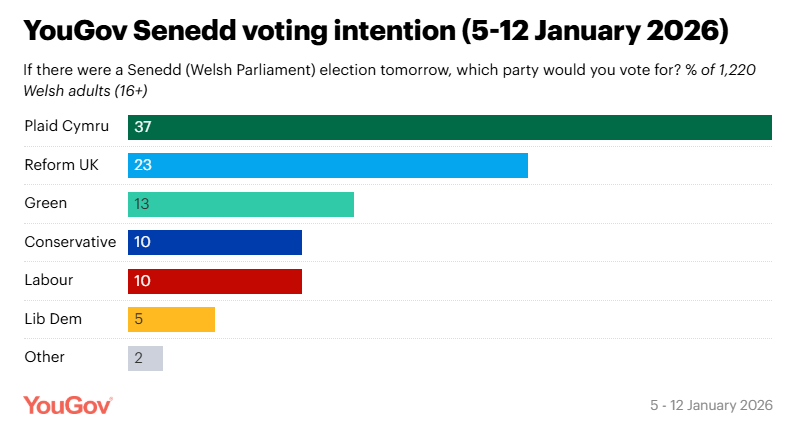
Breakdown of polling intentions in May 2026 Senedd elections, YouGov. January 2026.
Whether it will play out as well for Plaid as this predicts or not, the fact that Wales seems to be making such a break with the English centre-left and centre-right is paradigm-shifting. For their part, Plaid Cymru figures like leader Rhun ap Iorwerth are confident that Wales is done with Labour, but seem cautiously optimistic about their own ascendency, given the rise of Reform.
Alba – Scotland: SNP hold on to the reigns.
In Scotland, though the end result is the same – as Ipsos predicts Reform and Labour will trail the SNP’s 32 points by 14 – the story of how Scotland got to this point is quite different. The Scottish National Party, once a leading anti-establishment and anti-Westminster party, has been branded by some with the same labels of complacency as Labour and the Tories. That is set to change however, as a pro-independence cadre is set to hold the Scottish Parliament for the SNP in May, hopeful to push the weak Westminster government to a referendum.
Labour have had mixed results in Scotland since devolution. At the 2024 General Election they became the largest party, pouncing on the Tories’ crumble, like they did everywhere else. But when it comes to the Scottish Parliament, as well as the increasingly-popular struggle for Scottish Independence, they’ve been shown to be made of pretty weak sauce. They routinely have come in 3rd or 4th place in these elections, as well as those held for Scottish Councils.
Nicola Sturgeon, burning out of office 2023 and fading into relative obscurity, was once a titan. For the most part, she is the reason why the SNP holds the place it does in modern Scottish politics, but since then the party has faced a slight decline under Hamza Yousaf and John Swinney. Nonetheless, intensifying talks of independence are making them increasingly more popular with the Scottish electorate, and they seem to be holding their position in keeping out Reform and Labour this time around. They, like Plaid, have recently won a by-election in a council seat, and seem likely to replicate this nation-wide.
Sinn Fein in the North.
Polling in the Six Counties is harder to pin down, but Sinn Fein are set to come out on top. Michelle O’Neill has overseen a growth of popularity during her leadership and captured attention because of her IRA background and Sinn Fein credentials. Latest numbers by the University of Liverpool predict the party will keep their hold on Stormont, leading the Democratic Unionist Party by 6.1%.
As a result of their prolonged dominance, there have been increasing talk of Irish unification, not just by Sinn Fein leaders and activists, but by British MPs. It is fair to say that whilst the shadow of the war in the North of Ireland is long, the campaign for Irish republicanism seems more likely to get a referendum now than at the time of the Good Friday Agreement.
A Celtic Storm.
The English state looks weak. This is especially the case in the domestic context, as autonomy movements gain more and more ground on the street and at the polls. Whether it’s through by-elections, assembly elections, growing demonstrations or direct action, Westminster seems to be losing its hold on areas it once took for granted.
There is only one poll that matters, but however premature it seems, current numbers put Plaid Cymru in the Senedd, keep the SNP in the Scottish Parliament, and Sinn Fein in Stormont, all edging closer to autonomy for their respective nations. May will tell if that prediction is borne out.
Image via: Cobblestone Media.

Leave a Reply