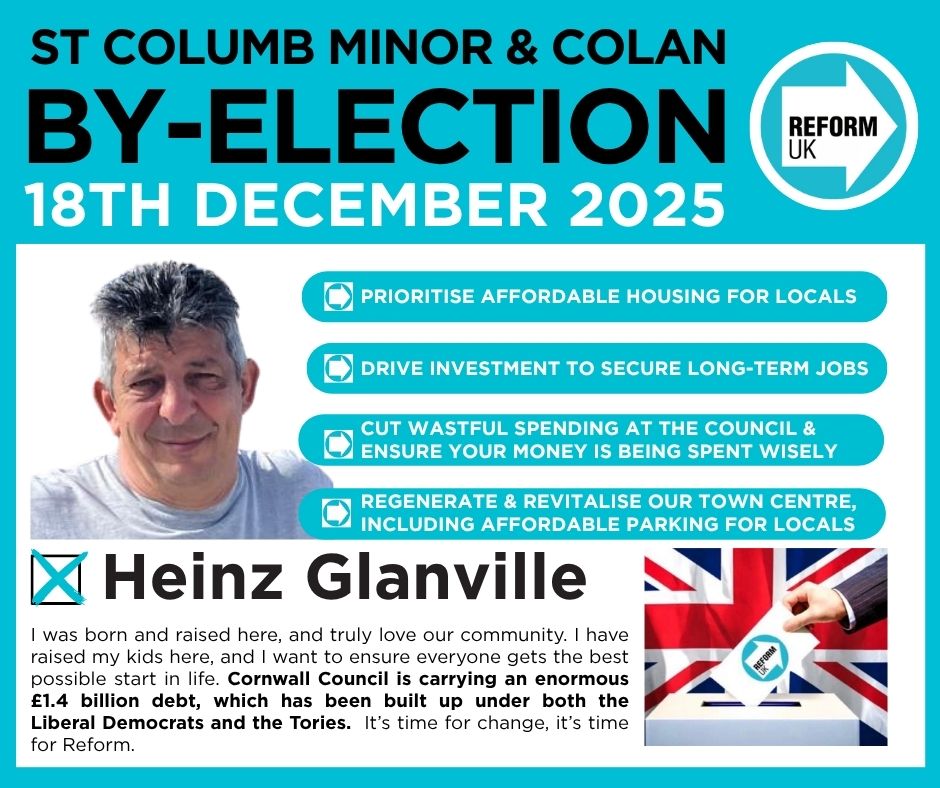
Yesterday, voters went to the polls in St Columb Minor and Colan, a council ward in North Cornwall. The winner, Heinz Glanville of Reform UK, is the successor to Christine Parsonage, another Reform councillor who resigned in November due to health problems.
Despite Reform being replaced with… well, Reform in this election, the party cannot help communities in Cornwall. They will abandon locals at the first opportunity, as is plain to see in the party’s grand strategy, which appears to focus solely on one or two national issues. In fact, Reform spokespersons seem unable to present a policy at the moment without mentioning immigration or inheritance tax — two issues that are the responsibility of Westminster.
Councils have been under increasing media scrutiny since May. This is largely the fault of Reform UK, who performed well and gained control of ten councils in the local elections. Fundamentally, local authorities act as a test of how the party will actually perform under the pressure of governing everyday issues, and in the case of Cornwall and other authorities, they have been shown to be useless, reckless, and helpless.
Christine Parsonage: one in a bushel of bad apples
The ward was previously held by Christine Parsonage, one of Reform’s 28 councillors elected in May. Her tenure was mired in a number of problems. For starters, she lived 45 miles from the ward she had been elected to, laying bare the inconsistency between Reform’s community-centred messaging and its tendency to parachute into constituencies where its candidates do not live. What’s more, she routinely neglected her role as councillor, failing to show up to meetings and causing outrage among local town councillors. Amid the defection of five councillors, personal squabbles in pubs, and tempestuous leadership bids, Reform’s ineptitude on the council was becoming increasingly clear.
She eventually jumped before she was pushed, defecting to the new non-aligned independent group on the council before finally resigning. This triggered a by-election in the ward close to Christmas, which returned a poor turnout — even by the standards of local authority elections — of just 28%, compared to the national average of 34%. The results were as follows:
Heinz Glanville, Reform UK — 408
John Fitter, Independent — 325
Geoff Brown, Liberal Democrat — 296
Frances Williamson, Green Party — 173
Mark Formosa, Conservative — 73
Stuart Hind, Labour — 9
Nigel May, Independent — 3
A new Reform councillor: likely the same as the rest
The new councillor for the ward, Heinz Glanville, remains something of a mystery. A small business owner with a relatively quiet social media presence since 2020, Glanville was the only candidate to have an address registered within the ward, with Reform clearly keen not to repeat old habits.
His election pitch included commitments to affordable local housing, long-term employment, and revitalising the local town centre. These are all pledges also made by the now-independent councillors who defected after becoming frustrated by Reform’s unwillingness to focus on local issues. This prompts a vital question in all electoral politics: what will be different this time?
Former leader of Reform UK on Cornwall Council Rob Parsonage, husband of Christine Parsonage, stated after his resignation that: “I didn’t realise how much of the national [strategy] drove the Cornwall Council side of life.
“My desire was to make a difference in Cornwall, to help sort out the debt, to improve the services for Cornwall, and that friction was definitely there.”
This is the true side of the far-right party. They care only for Westminster squabbling and little for the local communities who vote them into elected office — ask Clacton residents how many times they’ve seen their MP.
Despite reports of dozens of policies put forward by Reform, their leaders — Farage, Tice, and Yusuf — talk about only a small number of issues, with immigration being the most obvious, and inheritance tax the most tactically astute for garnering voters and funders in the upper classes. What’s more, their complete lack of experience in government and lack of tradition as a party point to the obvious conclusion that, from parish councils to Parliament, they are a party built on the political acumen of one man.
Bigger than local councils
This is not about Heinz Glanville — or any other Reform UK councillor — as an individual or community member who bids to sit on the council. They may well be “committed citizens” who genuinely want to improve things at a local level, though this is doubtful in most instances. They may state their intentions to fix potholes, make housing more affordable, and provide jobs in the community. However, if the organisers of the party structure are megalomaniacal fascists with alleged histories of neo-Nazi bullying, that becomes a very difficult line to toe.
It is an unfortunate trend in much of rural UK politics that Reform have captured local councils, in all instances for the worse. As a consequence, the media spotlight on councils is harsher than ever. Local councils have power over the bread-and-butter issues of everyday politics: planning permissions, council tax, transport links, etc., and these decisions should be made by people who live in the local community, have a genuine interest in democratic accountability, and maintain a separation from the soap opera of Westminster.
Ultimately, criticism of Reform in their protean state is the best hope for antifascist and anti-racist electoral politics. Farage and his clan are a danger, and while it is vital to communicate their threat to black and brown people en masse in this country, demonstrating their sheer incapacity to run any level of government is also important. In their eight-month stint in local authorities, Reform’s organisers have shown themselves to be the lacklustre far-right agitators they have always been.
Image via: Facebook.
Leave a Reply