
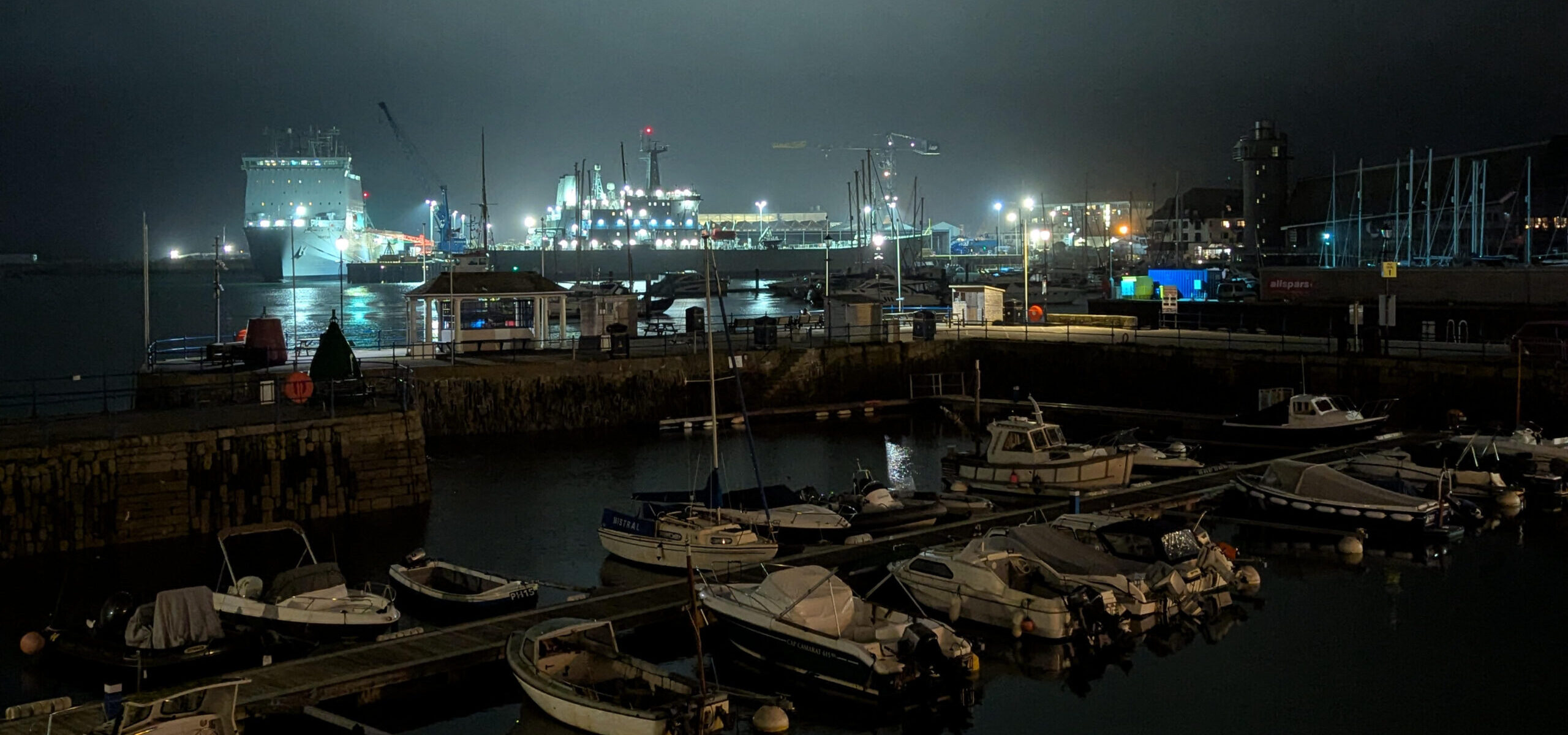
In May 2025, the plan to dredge Falmouth Docks was announced. Already the 4th deepest harbour in the world, the expansion has been planned to allow larger vessels to dock by the town. The redevelopment is still technically awaiting approval from Cornwall Council, but the Government has introduced planning reforms to fast-track the approval process. Questions about the social and environmental impacts have been raised, with the unique marine life and local livelihoods at risk.
To go ahead, the scheme will also need the approval of the Marine Management Organisation, to which A&P Falmouth Limited (the operator of the docks) have submitted a request for a Marine Licence Application. A decision by the MMO is looming.
What is especially astonishing about a development with such huge impact is the lack of public consultation. Cornwall Council’s decision on the proposals, which could be made in a matter of weeks, may not even go to the Planning Committee. Unless one of Falmouth’s Cornwall Councillors steps in, the decision will be made by officers behind closed doors.
The plan has been scrutinised by Cornwall Wildlife Trust (CWT) and others have asked for stricter monitoring and mitigation measures. CWT has issued a formal holding objection, citing concerns about the environmental modelling and sediment surveys underpinning the application.
According to CWT, modelling done by the docks’ own environmental consultants does not preclude the “possibility” that tributyltin – a now-banned and highly toxic antifouling chemical – could pose major risks to the marine environment.
CWT and Falmouth’s local fishing community argue that the Environmental Impact Assessment underestimates the influence of wind and tidal movement, failing to account for the full range of wildlife using the harbour. Without mitigation and constant monitoring, the effect on the Fal’s marine life could be catastrophic, as chemical-rich sediment is spread along the headland during the dredging.
Further objections surround the proposed disposal of “non‑hazardous” dredged material at sea, just beyond the Fal Special Area of Conservation – one of the UK’s ‘most beautiful and biodiverse marine protected areas’. CWT says the Docks’ Environmental Statement does not adequately assess how dumped sediment will move or what fragile habitats, including reefs, sea grass, or Mearl beds it may smother.
The Trust has also raised concerns about intended end-use, as the proposed dredging is driven by proposals to allow cruise vessels to dock. Extensive research has shown that cruising is a major source of environmental pollution and degradation, affecting air, water, soil, fragile habitats, wildlife and human health.
Local fishers fear contamination, habitat disruption, and the death of their industry. Oyster fishers warn that the development could jeopardise the Fal oyster fishery – the only wild oyster fishery in Europe and a cornerstone of the region’s cultural identity and tourism economy.
Once any dredging is complete, a huge amount of highly toxic dredged materials, equivalent to around 12,000 lorries, would have to be driven from the docks. The lorries would then have to be taken through the town and onto the A30, with the nearest facility around 200 miles away. The other option currently under consideration is to re-route the Falmouth Branch line to removed waste by train.
Its supporters argue that the project will bring high‑value jobs and strengthen Falmouth’s maritime economy, with the construction of wind turbines planned alongside a significant expansion of the cruise industry. Developers estimate that the number of visitors coming to Falmouth will quadruple to 200,000 every year, each spending approximately £59 per person. However, planning documents note that up to 80 coaches per day will transport passengers to destinations outside the town, raising questions about how much of the spending actually occurs in Falmouth. Critics also question the £59 per head figure – with most cruise ships offering fully comprehensive catering on board, it is likely that most cruise visitors will spend far less in the town’s shops and cafes.
The proposals, first submitted last year, were reviewed early in the consultation process by Falmouth Town Council’s previous administration. No objections were put forward to Cornwall Council, though Jackie Walkden (now a Green Party councillor for Arwenack) had raised the issue of lack of monitoring and the threats to marine life before her election. Overall, concerns are growing that there is not sufficient public knowledge or discussion of the proposals.
Once the Marine Management Organisation has received evidence it deems sufficient, the future of the development could be decided in a matter of weeks. Many in Falmouth are still in the dark about how their town and local environment will change. The proposals represent a broader struggle over who gets to shape the town’s economic and environmental future – and at what cost.
Image via: Cobblestone Media.
Leave a Reply